Racks and Shelving Display Counts

One of the data points we collect at Haynes & Company is the amount of retail floor space occupied by a certain product. We calculate this through display counts, which are related to the type of rack or shelf you may find, in combination with project specifications.
You will record TOTAL number of displays for each product category, including fractions of displays.
You will encounter a few different types of floor racks for apparel.
Floor Racks
You will need to pay close attention to how you count racks. Often racks will contain more than one inventory category. In these instances, you should count the displays in decimal form.
1. T-Racks
A common rack you will see is a t-rack, like the rack shown below. Most t-racks have 4 independent "arms" (some have 6 or 8) that hold merchandise. This rack is counted as one display, unless multiple brands or categories are shared on the rack.
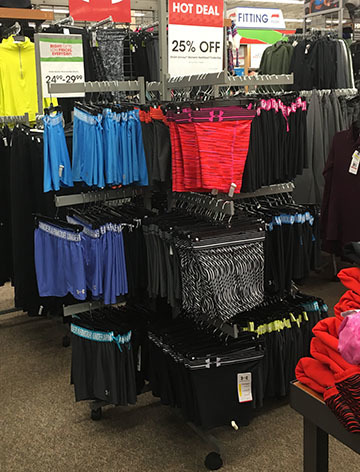
For example, if you encountered the above rack, which has bottoms on all visible arms, you would record the following: Bottoms: 1 display.
2. Round Racks
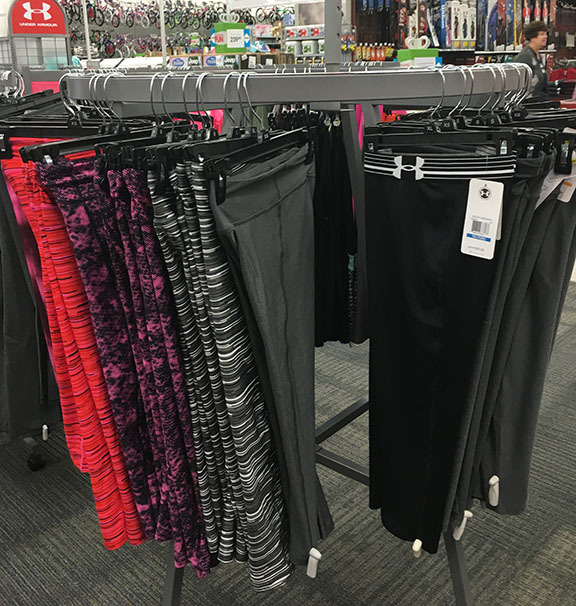
The following "round" rack would be considered one display, recorded as: Bottoms: 1 display. If, for example, the rack was approximately 1/2 bottoms and 1/2 tops, you would record: 0.50 bottoms and 0.50 tops.
3. Wall Racks
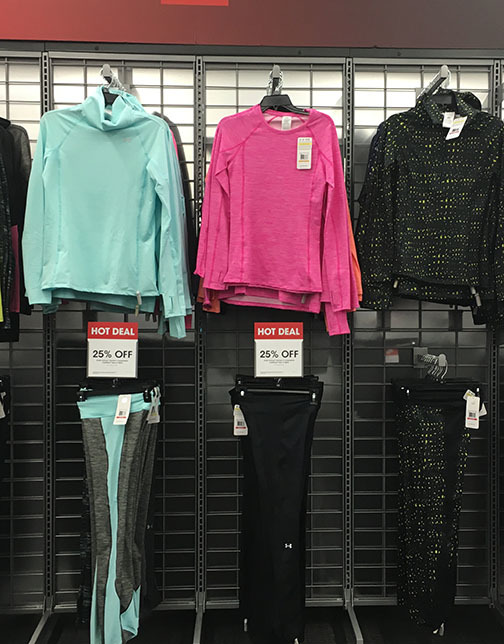
A wall rack is a rack that extends from a wall or the end of a display. For wall racks, you will record each arm of the unit independently. Wall racks can be attached to walls and can also be attached to displays. Wall racks can also be counted in decimal form if more than one type of inventory shares the same peg.
For example, in the example below, you would record: Tops (t-shirt/long-sleeved): 3 displays; Bottoms: 3 displays.
Tables & Shelves
Tables and shelves are commonly found on the retail floor and are recorded in display counts.
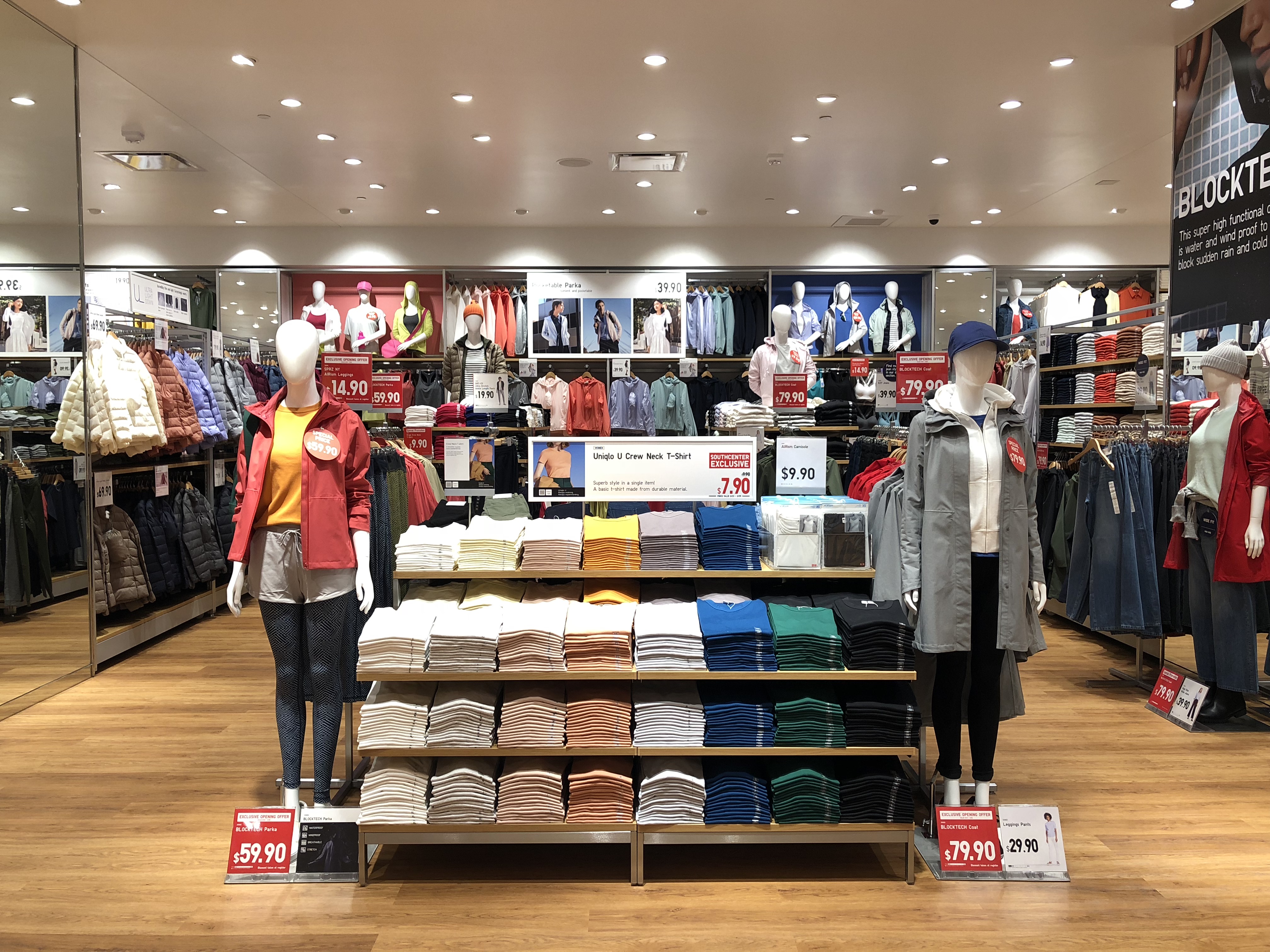
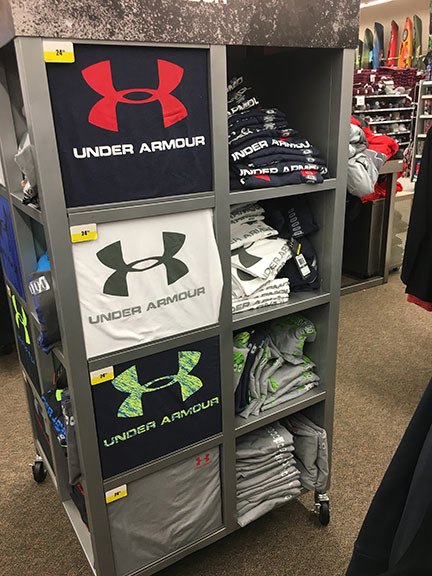
Shelves may be freestanding (like the photograph below) or attached to a wall unit. You will count each of these shelving types the same. Each shelf and each face of the shelving unit should be counted independently.
For example, for the visible display in the example below, you would record: Men's Tops (t-shirt/long-sleeved): 4 Displays.
Under Armour also often has "cubbies" where shirts are housed. You will count this as one display. You will not count this as four shelves/displays.
Combination Displays
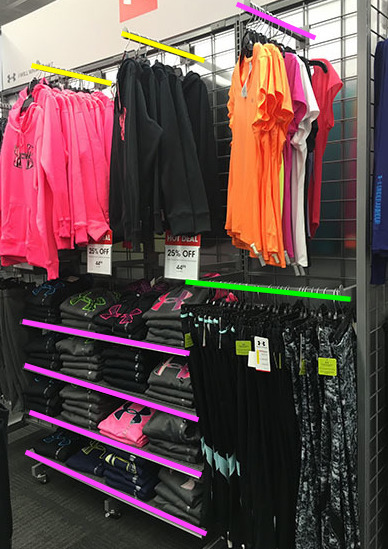
A combination display is multiple displays/racks combined into one floor unit. These types of displays use a combination of data collection methods and can be the trickiest type.
For these displays, you will record each display type on the unit separately.
For example, in the following photograph, you would record: Tops (t-shirts/long-sleeved) 5 displays (one wall rack and four shelves); Jackets (jackets/hoodies/sweatshirts): 2 displays (two wall racks); Bottoms: 1 Display (1 floor rack).
Comments
0 comments
Article is closed for comments.