Display Counts

For both Women's and Men's Apparel, we are interested in how much selling space is occupied by each brand. For each department, you will collect a count of display types by brand and category.
Inventories for some of these brands can be sparse at points, so you will likely have partial display counts for some categories. Since we are using the display counts as a proxy for inventory, you will want to count every surface that contains inventories from our brands/categories.
The most common you'll see are:
- Floor Racks
- Tables or Shelves
- Wall Racks
Below are examples of what you may see and how to count them.
Floor Racks
- T-Racks
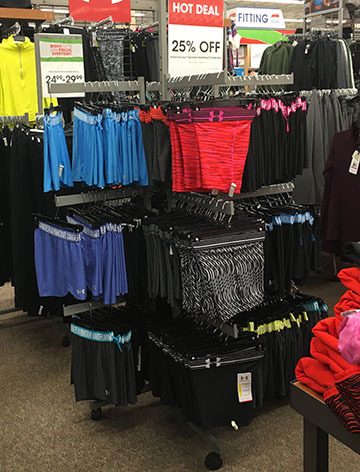
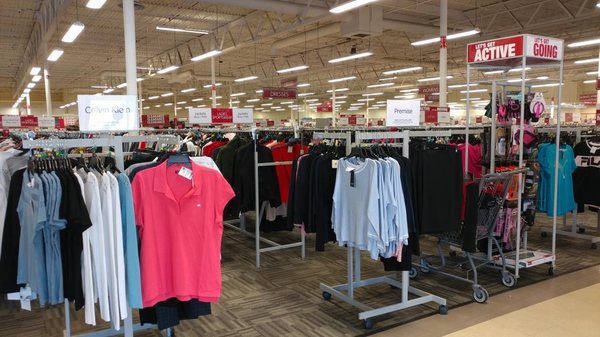
T-racks are very common and usually have 4 independent "arms" (some may have as few as 2 and others as many as 8) that hold merchandise. These racks stand alone on the floor and can hold a variety of categories of items and each arm should be counted as its own display. For example, if a 4-arm rack had two arms that held Women's Adidas, and two arms that held Women's Nike, you would record: 2 displays Adidas, 2 Nike
The example on the left shows 12 displays of Under Armour Notions while the example on the right shows two displays of Women's Adidas Tops.
- Horizontal Rack
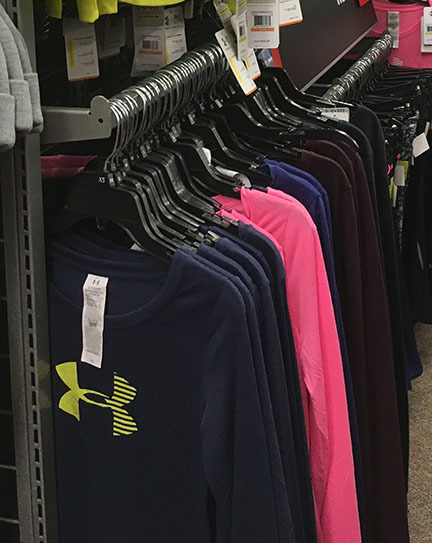
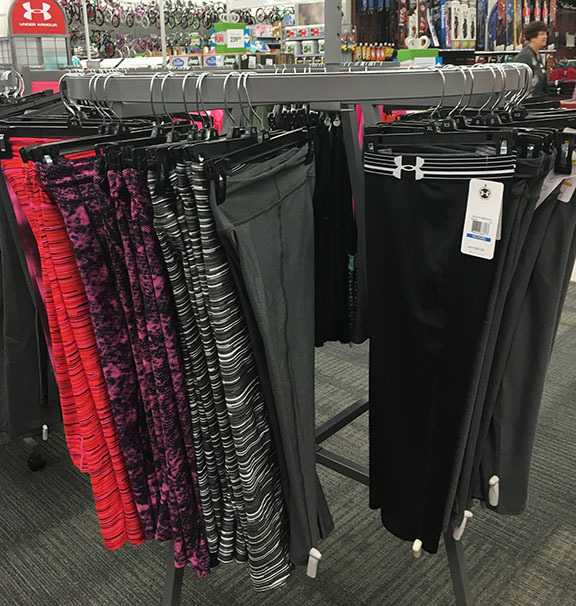
The most common type of rack you will see at Burlington is a long, horizontal rack. These racks can be found holding only one category of inventory, multiple categories, or they could be found holding a variety of categories and or mixed in with items we don't collect data on.
For example, below, the rack has several different styles of Under Armour Tops, but since it is all the same brand and category of inventory, you would record just 1 display of Under Armour Tops.
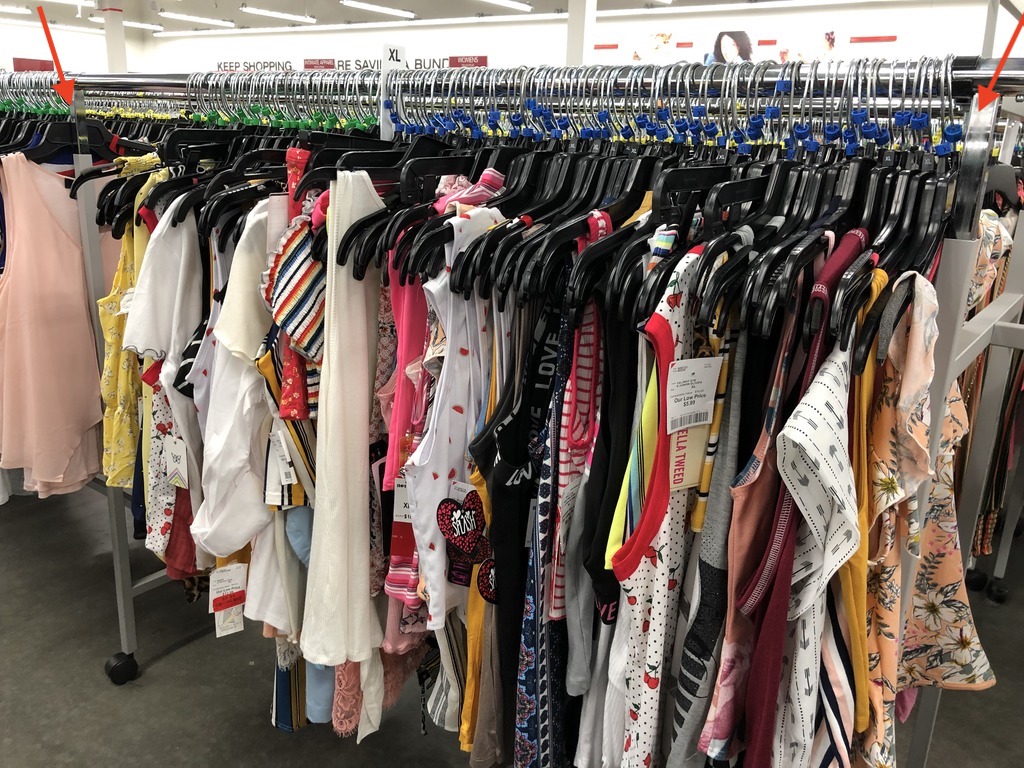
It's very likely you will see very long horizontal racks at your store that run the entire aisle. Keeping in mind, we are using display counts as a proxy for inventory, we want to make sure we are not counting these aisles as one rack because we want to see the fluctuation in space that occurs between visits.
To get the best count, you will break these racks up by every set of legs, with each set of legs counting as its own rack. For example, in this photo, the red arrows indicate one floor rack.
It's likely the brands will be mixed up and/or that there will be items mixed into these racks that are not the data we need for this project. It's also possible that the brands/categories we need to collect data on are scattered on different racks. In these cases, we need to estimate, and visualize if ALL Women's Adidas Tops inventory was on the same rack, how much space would it take? One rack? Half of a rack?
- Round Racks
Round racks will be counted as one display, so if there is inventory from multiple brands on the same round rack, you'll record how much space each brand/category is given. For example, if the round rack was 3/4 full of Adidas Bottoms and 1/4 full of Under Armour Bottoms, you'd record: 0.75 Adidas, 0.25 Under Armour.
Wall Racks
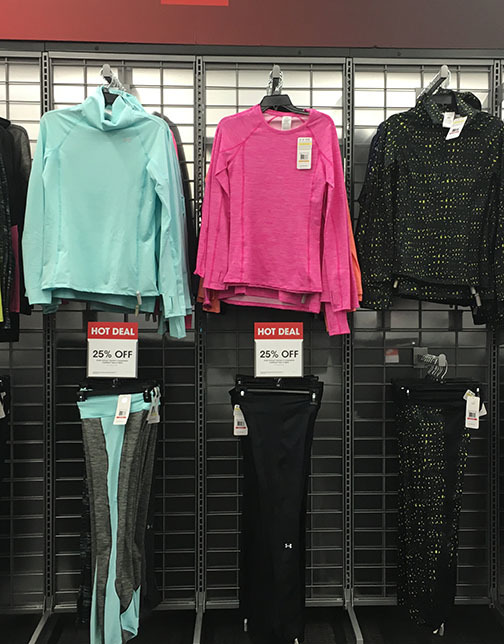
For wall racks, you will record each arm independently. Wall racks can be attached to walls and can also be attached to displays. Wall racks can also be recorded as partial (decimals) if more than one brand shares the same peg.
For example, if the sweatshirts and bottoms seen were all Under Armour, you would record: 3 displays for Jackets and 3 displays for Bottoms
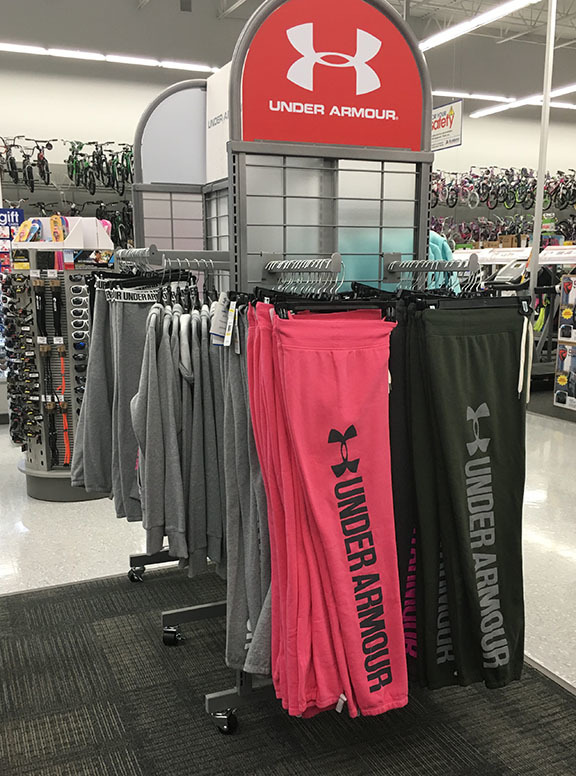
The following is an example of wall racks attached to a display. For the inventory facing us, we'd record 2 displays Under Armour Bottoms.
- Combination Displays
It is also likely that you will encounter display combination displays that are a combination of hanging racks and shelves. For these displays, you will record each display separately and log it for the appropriate brand and category. 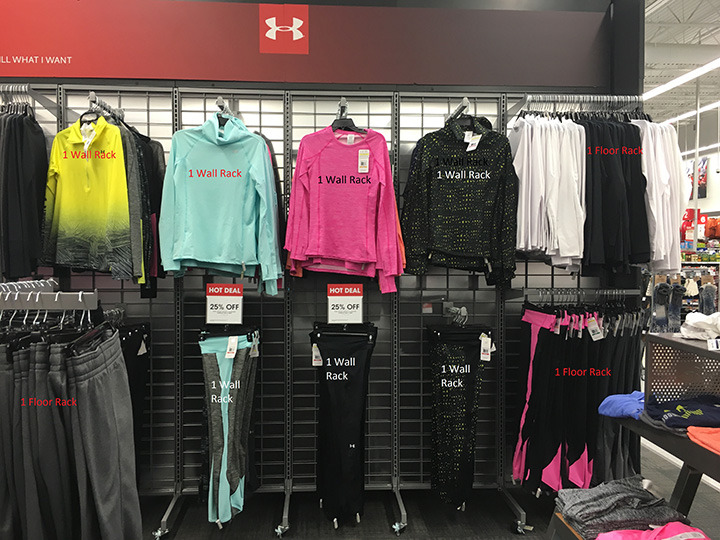
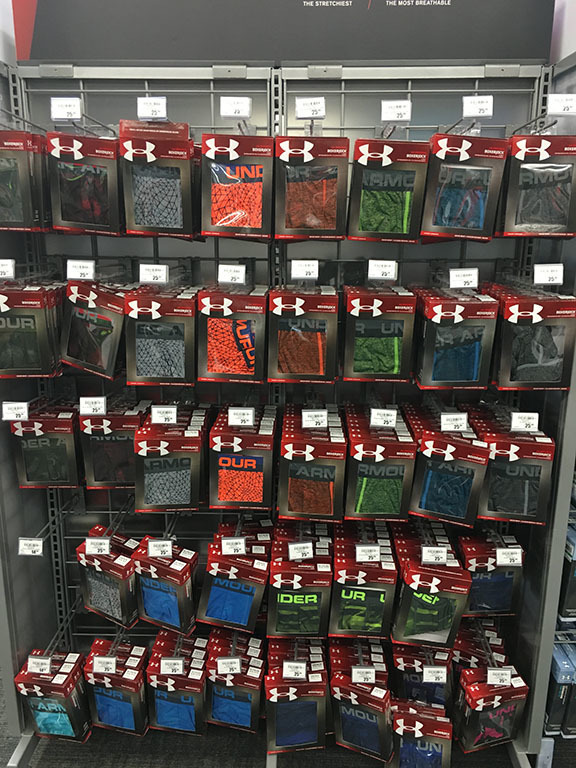
- Underwear Wall Racks
For underwear only (not sports bras), which are on very small little wall racks, please count each verticle row as a "shelf" versus counting each peg.
For example, if you saw this display, you could record 5 displays of Under Armour Notions.
Tables & Shelves
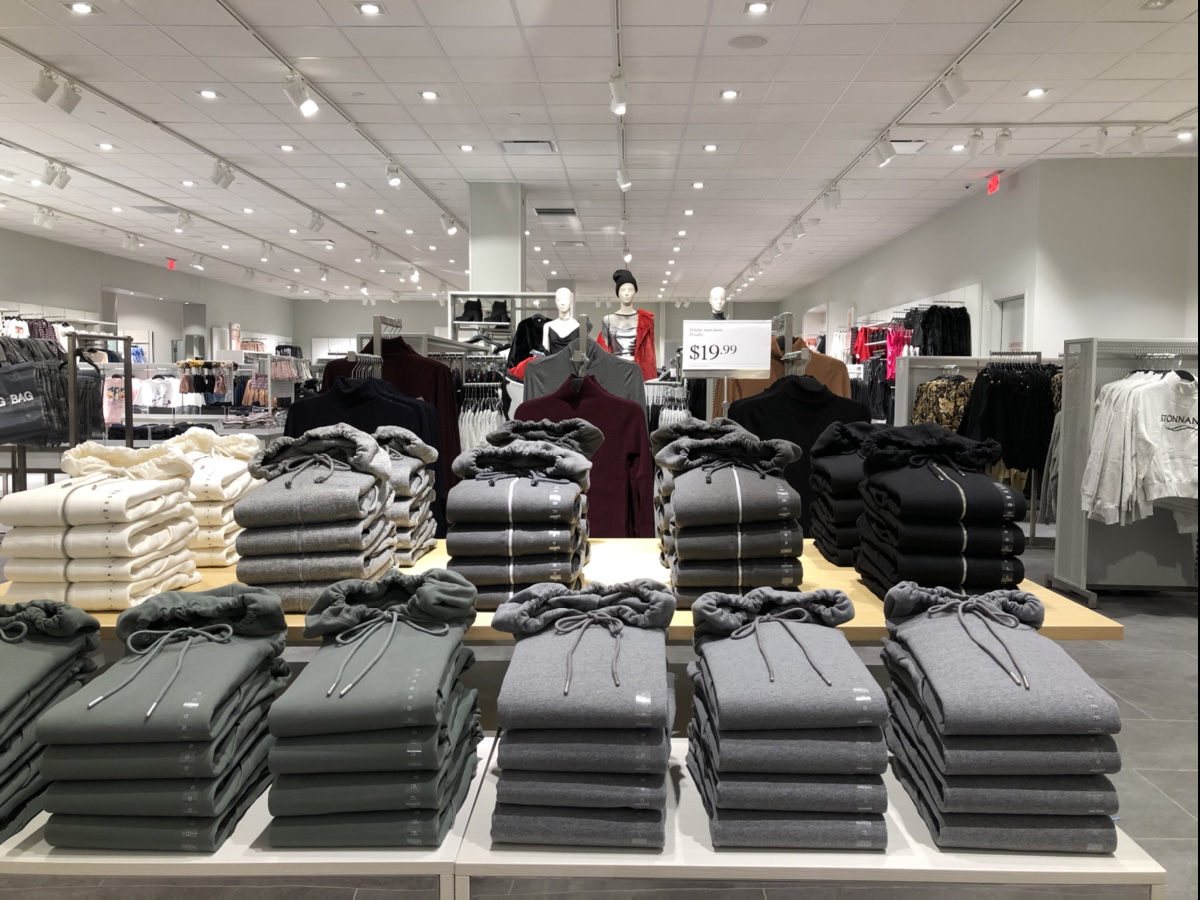
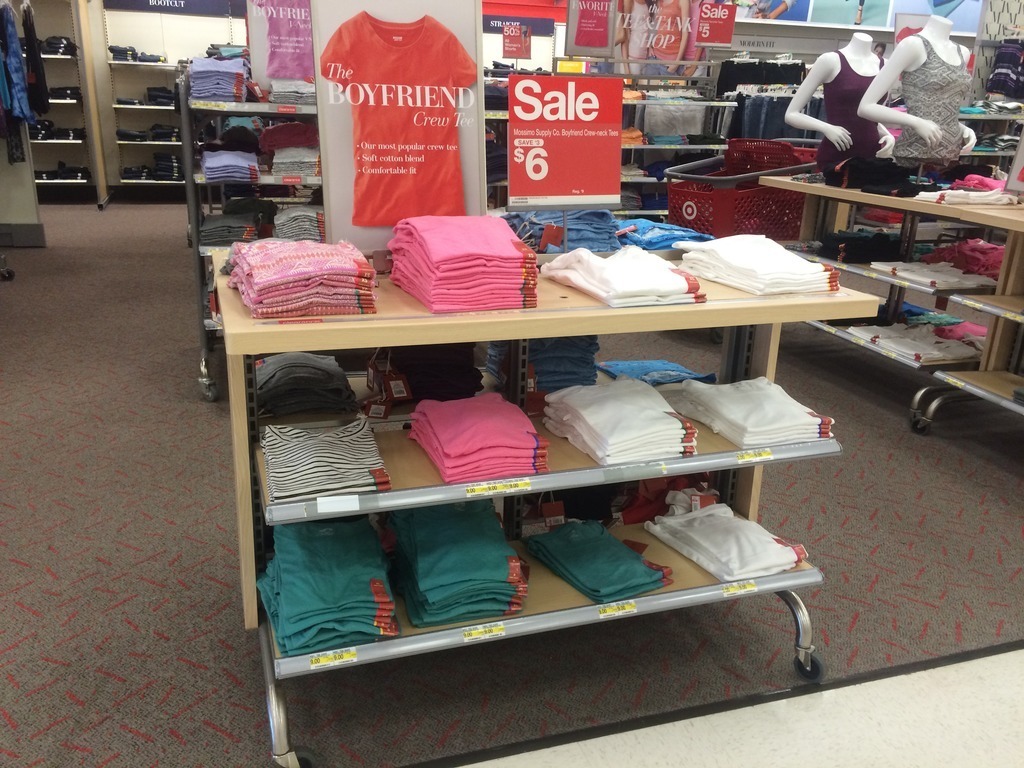
For Tables and Shevles, you will count every surface that has inventory on it. For instance, if you just have a regular table, that would be 1 display. If you have a set of shelves, you would record every shelf as a display.
For the example below, you'd record: 2 displays of Adidas Jackets
For the example below, you'd record: 6 displays of Women's All Other Brands Tops.
Pushing inventory together to get an accurate rack count.
While racks may seem "full" it's quite likely there is a great deal of space between items based on how the store stocks their inventory.
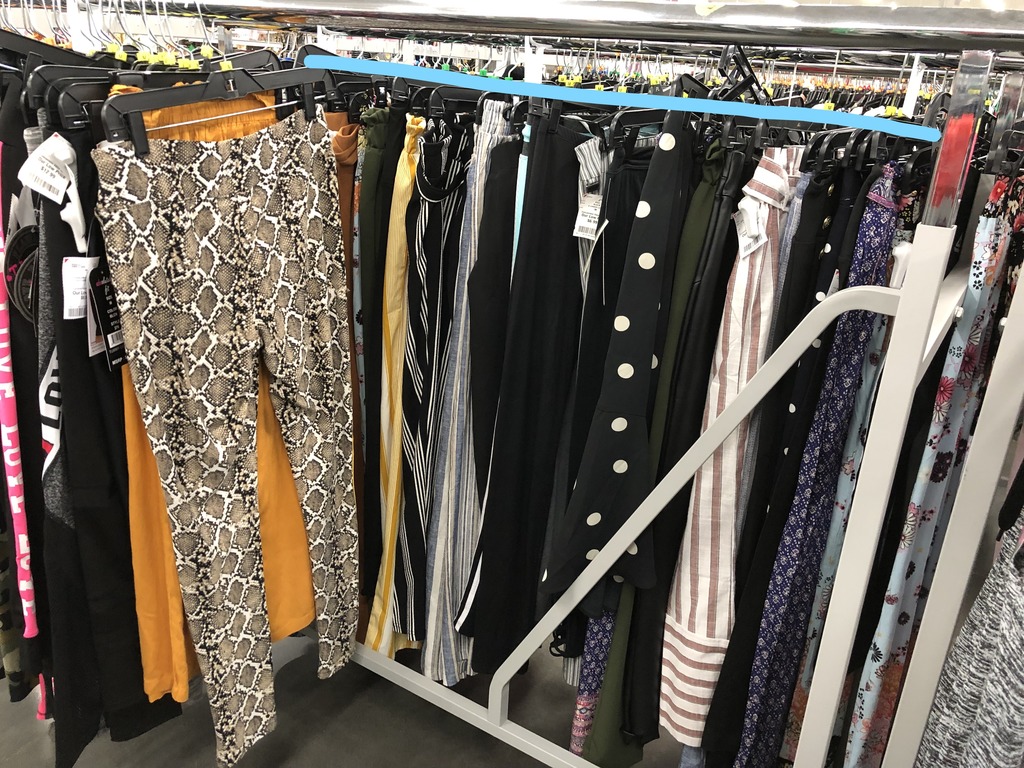
To get an accurate count, that actually has some fluctuation between months, we want to push all of the inventory to the end of the rack so we can decide if the rack is a full 1 rack count or more like a 1/2 rack count.
This may seem a bit awkward, but we want to count the inventory space and not the actual physical racks. It's pretty quick to do after you check the pricing for the particular rack.
For instance, in this photo below, the blue line is the empty space after the inventory is pushed together - making a "full" rack much less full!
Comments
0 comments
Please sign in to leave a comment.